
 English
 Slovenčina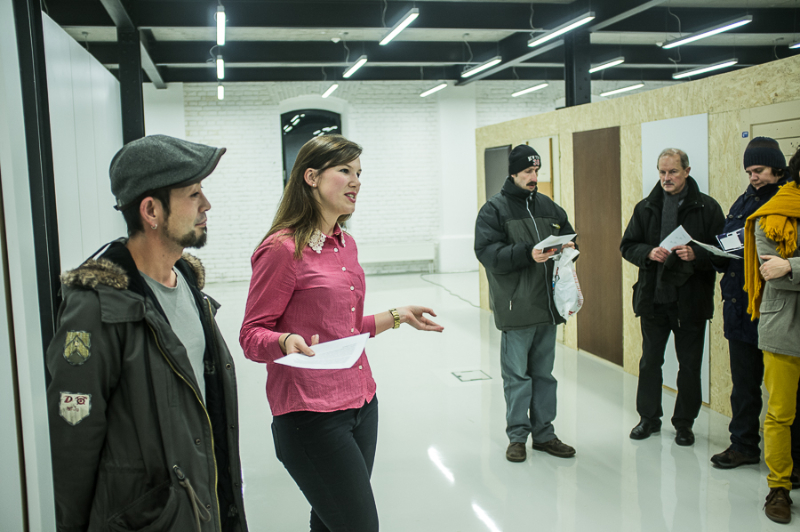
Home » Archives by category » News (Page 12)
Competition: Urban Impact will impact all residents of Košice
To what extent can modern painting or architecture impact lives, or city stereotypes? How can tediousness of city reality be thwarted? Such were the issues the contestants in Urban Impact, a public fine art project, were faced with. The contest aimed at working out a specific project integrating visual art into city organism, into its public space, and point out the long-needed presence of visual art in the city. The contests could draw inspiration from manifold means of expression balancing between an object, site-specific art, and urban art. Project should cover strategic city public spaces – select location, mutual relationship and significance. And we know the winner. Out of 15 competing projects, the proposal coming from a young painter Radovan Čerevka resonated with the jury most. As the proposal entails a strategy of secret and surprise, the office of ECC Košice 2013 decided to keep the name and location hidden for now. For now, we can say the assessment report read that the proposal was perceived positively for its ignitingly provocative and ironic concept. “Its placement in the key pastime zone creates a space for social discourse and public activation. The proposal has a potent media potential, it nags the public and stimulates to declarations of various (even negative) social attitudes and protest activity, and at the same time, affects the public in its environmental and ecological stances. In the sphere of public space (even in conditions of public tenders), it introduces a less frequented means of provocative pouncing at one of the most burning current issues, such as interconnection of big corporate interests endangering ecological stability of the environment with public politics, or the indifference to public affairs, which leads to irreversible negative consequences,” stated the verdict of the jury on its selection. Radovan Čerevka (1980) has lived in Košice all his life. He attended prof. Bartuszs’s sculpting atelier at the Department of Fine Arts and Intermedia at the Technical University in Košice. Currently, he is student of master studies at Vysoká škola výtvarných umení in Bratislava. He is a member of the Kassa Boys art group. He stages his work at exhibitions in Slovakia and abroad on a regular basis. In 2005, he was a finalist in a prestigious Slovak prize awarding young painters – The Oskár Čepan Prize. In the Czech Republic, he stirred public attention by the manipulated portrait of Petra Buzková with a black eye, which he created in 2006 for an Amnesty International exhibition dedicated to violence against women. You can see R.Čerevka’s work at an exhibition titled Iranian Komplex, which is on display in the National Theater Gallery in Praha until January 11, 2009. Interview Peter Beňo: What decided was the provocative and ironizing nature of the project Painter Peter Beňo, who was on the jury of Urban Impact, thinks its main theme was to highlight a city public place in an innovative artistic manner and to bring the undergoing cultural transformation of the city into the forefront. How did the original idea behind the competition develop? It was Michal Hladký, the author of Interface project, who initiated it. He addressed me to consider the collaboration on the project. In the end, we put the idea together and concept behind the project as well. We have also completed the concept of next year’s competition, when we would like to see more project proposals, maybe from foreign painters as well. I hope we will succeed in establishing an event with an international participation on a cyclical basis that would be part of a project within the ECC 2013 and would promote new visual culture in a public city space. Have you managed to meet the expectations, which you had when you initiated the competition? We wanted to keep the competition rather non-formal. In the end, we had to observe certain standard administrative conditions. The jury was assessing anonymous proposals – by score evaluation in the first round, and joint discussion and consensus in the second round. I however think the event’s primary contribution lay in stirring up a debate on a city public space, on certain locations and their potential, which, to some extent, initiated a discourse of significance. Meeting experts who make up the jury mostly spurs valuable impulses, which are worth noting. In this case we have somewhat succeeded in defining the position the virtual art finds itself in a public space – not just in terms of elements shaping it, but in terms of a significant social phenomenon as well. How would you assess the quality standard and the amount of submitted proposals retrospectively? I have to admit that we had expected more proposals from established painters or architects. Due to the low number of proposals, we moved the competition a month ahead. Eventually, we received 15 proposals to consider. Most of them were of very average quality, be it in terms of conceptual or visual rendition. Many proposals had some potential, but they had not been complete enough – they rather served as means to open up a discussion on how they could be concluded or integrated into the visual or social framework of the city. Some noteworthy proposals sprang up in the second round, but mostly during discussion sessions. Why did you decide to award Radovan Čerevka’s proposal the winning title? The winning proposal, which had scored the highest amount of points in the first round, passed into the second one with a very high ranking. The projects that came first and second had risen above the others from the start. I believe the urge to confront our environmental, political or social stance with a rather controversial gesture in the midst of a society drowsing in lethargy, was present in every juror. That was the decisive factor. It is rather paradoxical to know the winner, but keep his proposal a top secret until it is publicly disclosed. Why? Since the project has a potential to reach wider societal, social and media circles, we decided not to disclose it just yet. We would not want to take the moment of surprise away from our fellow citizens. Where and when will the project be disclosed? Disclosure will come in due time. It depends foremost on the author. Then, we hope, this project will affect the cultural and artistic arenas. It can thus bring the public discourse into re-evaluating the task and the influence of visual art on our society. zuzana.lehotska@kosice13.sk
Marseille Calling: The French have not celebrated the title yet
Another city will share the European Capital of Culture 2013 (ECC) title with Košice -the French city of Marseille. Based on the up-to-date information, the composition of the French team has not changed. Since they worked under immense pressure, and experienced due stress before the results were announced, the team was naturally overjoyed to have won. After they savored victory, they eased up to get ready for the phase awaiting them, which would be much longer and much more challenging. What were the reactions of Marseille citizens after obtaining the title?This question is quite difficult to answer, as Marseille-Provence is a vast territory with 2.2 millions inhabitants involved. It would be very pretentious to pretend that every single citizen had a reaction! If we can measure something, it is the awareness of a vast majority that Marseille was again in the race for being the important European City it deserves. What was the reaction of French media during the competition and after the victory of your city? As usual, we must separate national media and regional ones. During the competition, the national press tried to publish a number of articles to compare the four cities still in the race (Lyon, Toulouse, Bordeaux and Marseille-Provence). These articles were mainly portraits of cities mixing economy, social, political and cultural issues. Mareille-Provence was generally seen as an important bid. Regarding the regional press, it was, of course, very supportive, specially the days before the visit of the Delegation of the jury. After the victory, national press was quite discreet when the regional press was publishing a massive volume of articles during the three days following the result. Are you planning to celebrate?No When will you visit Košice to discuss future cooperation?We met the Košice team at the end of last year and decided to come around May after the European Council of Ministers would have nominated officially our two Cities. (mr)
Contest to claim the 2015 title in the Czech Republic has commenced
In early February, the Ministry of Culture of the Czech Republic officially commenced the prestigious contest to claim the European Capital of Culture title in 2015. Select Czech city will share it with its Belgium counterpart. The ECC notion is not new in the Czech Republic. Prague boasted the title in 2000. According to the report of the Czech Ministry of Culture provided to our Interface News, four cities have expressed an interest to run so far – České Budějovice, Plzeň, Ostrava and Hradec Králové. Plzeň wants to outgrow its beer reputation We have reviewed the web sites of the potential candidates for the title, and we have found out Plzeň has taken the information and communication campaign probably the furthest. We were greeted by the candidacy logo when we entered the site. In candidacy manager, Petr Šimon’s opinion, Plzeň, or Pilsen, mostly evokes associations linked to beer in Europe and around the world. “We are proud of the fact, of course, but our goal is to take Plzeň beyond parallels drawn with the renowned beer. Plzeň in the European context aims to become a work of art with rich internal structure involving much more than “the beer culture”. For this reason, Plzeň does not take its candidacy lightly, and builds on the previous intensive year-and-a-half preparation. Vision’s authors are convinced that making rich cultural tradition and candidacy vision meet, Plzeň shall become an attractive, open, affable, and pulsating city. Other cities are still deciding Ostrava runs as another contestant along Plzeň’s flank. Hradec Králové and České Budějovice are still pondering. The winning Slovak team Košice 2013 has been following the Czech contest diligently. “We met with the Ostrava team several times last year and informed it about latest developments in the contest, in our project and about drawbacks of the candidacy and the individual rounds of the contest,” noted Alena Vachnová, manager of Košice 2013, n.o.”It is true Hradec Králové is considering the candidacy, but the city council has not made the final decision yet,” said Aleš Mokren, head of culture, sport and tourism section at the Hradec Králové’s City Council. Mayor of České Budejovice, Juraj Thoma, was present at the oficial commencement of the ECC contest which took place on February 10th in Prague. He said he listened to the opportunities the project posed with interest. “České Budejovice is not considering taking active part in the contest at the moment. We prefer projects of a long-term and sustainable effect as opposed to a surge and short-term one. I am however certain the European Capital of Culture project is an excellent marketing chance to bring the city to the spotlight and attract potential visitors. Because our partner city Linz is the European Capital of Culture 2009, we have a good opportunity to determine what specific advantages the project offers, what preparations it demands, and what it involves all in all. Then we can decide whether we want to enter the contest or not,” said Mr Thoma. Candidacy application to the Czech ECC 2015 in conjunction with the presentation of the project’s primary features must be submitted by the end of October 2009. After the deadline, a two-round national contest shall take place. The winner shall be decided by a selection board. In late summer2010, the Council of Ministers shall be officially nominated the Czech winner and its Belgium counterpart European Capitals of Culture 2015. More information about contest development and candidacy conditions is available at http://www.mkcr.cz/evropska-unie/evropske-hlavni-mesto-kultury/default.htm zuzana.lehotska@kosice2013.sk
4th BUCHAREST INTERNATIONAL JAZZ COMPETITION
4th BUCHAREST INTERNATIONAL JAZZ COMPETITION 7 – 13 May 2010 for BANDS and VOCALISTS General Information Place Bucharest Eligibility Bands may have up to 6 performing musicians. instrumentalists and vocalists instrumentalists vocalists Age limit Applicants must be born after 1st of May 1975. Registration deadline February 10, 2010 – date of postmark or courier service stamp Prizes The total amount is 7,000 Euro, cash and concerts. Complete information jmEvents.ro C.P. 13 – 63, Bucharest 13 Phone: +40 722 383 542 Fax: +40 21 323 66 00 office@jmEvents.ro www.jmEvents.ro
French Culture Days will lure with sound of glass, film, and chocolate
The tenth French Culture Days (March 23 – April 17) will close the chapter comprising the decade-long series of the traditional several-week-long event in the Eastern Slovak metropolis. As of next year, Alliance Française in Košice would like to present Francophone culture throughout the year. The initiative is a piece laying out the world-wide mosaic of French Culture Days, which are organized every March. Art glass exhibition called D´ores et d´espaces in Vojtech Loeffler’s Museum, an opening event of the initiative, will be a treat for Košice in organizers’ opinion. “The exhibition, with the title which eludes exact translation (Here and in This Place) and may seem too classic, will however portray something unprecedented. Glass will team up with sound, and sound effects, and attempt to create a single whole,” noted Grégoire Brault, director of Alliance Française in Košice and the attaché of the ambassador of the French Republic, about the upcoming event. Art photography exhibit will disclose physical and mental nakedness in oeuvre of the renowned French photographer Marta Jonville in J. Boccatius’ Public Library. “I look forward to the concert by the Senegalese band Lack thyossane taking place in the ballroom of City District Košice – Staré Mesto, because this year’s French Culture Days shall become Francophone culture days thanks to their concert. Senegalese are not French, but belong to Francophone countries. They will present African-French music, which is hard to come by in Košice,” divulged Roman Gajdoš, president of Alliance Française . G. Brault praises the partnership with local cultural organisations in Košice. “French Culture Days initiative with its ten-year tradition does not have to force itself onto residents of Košice to be promoted any longer and run without support of local organisations. Majority of events are organised in partnerships with museums, galleries, City Council or City District Košice – Staré Mesto. We also collaborate closely with the ECC team.” During French Culture Days, as many of us have already discovered, culture transcends language and language barriers. “Exhibitions and music speak a universal language. This year, we are going to make a series of French films more accessible to a wide spectrum of audience through Slovak subtitles,” added Mr Gajdoš, who has not registered an increased public interest in studying French, despite the fact the French city of Marseille will hold the ECC title in 2013 along with Košice. French Culture Days will close with a sweet treat to the taste buds with the presentation of the renowned French confectioner – chocolateur. “Those who make it to the event will find out more about chocolate’s history, ways of preparing it, and will witness its creation. They can try out the quality of a freshly made chocolate on the spot, during degustation,” said the president of Alliance Française on a closing note. zuzana.lehotska@kosice2013.sk
John Flamson: European Capital of Culture is not a reward but a scholarship
Ever since its upswing the 19th century, the English city of Liverpool has been most famous for the perhaps most renowned pop English band the Beatles. Once a significant industrial city, it turned into one of the poorest ones in the United Kingdom of the 20th century. New impulse kicked in with the new century and John Flamson, the director of strategic development and planning at the University of Liverpool who was involved in creating the city’s new image as European Capital of Culture 2008. He attests to the fact that the candidacy spurred new projects. He has come to Slovakia to share positive experience with organization of the biggest cultural initiative in Europe. We bring you the transcript of his speech on February 11, 2009 in Košice. It has taken Liverpool 25 years to leave its problematic reputation behind and create a change general consciousness. City administration was run centrally, leaving the city unable to take care of itself. It was a long and curvy road. Košice must awake to its history – how the Velvet revolution affected perceptions of the city; what was reconstructed, and what is the characteristic of this decade and what should be pivotal in the next one. You should not rely on the state money. From the way you are shaping the ECC programme I can see you are on the right path of collective leadership – collaboration between public and private sectors. Partnership and joint effort are crucial. It is necessary to work on it within the ECC but also allow other initiatives to join the process. When people start saying “us” instead of “them”, you know you have achieved a breakthrough. Significance is judged by relevance to the citizens. For this reason, it is necessary to be self-critical. ECC came after many projects had been completed with success – it was a continuation of something good that had been accomplished previously. It took us a long time to start considering the candidacy. This contest had been perceived as an opportunity to build the city’s new image, because Liverpool had a rather troubled past. Sir Bob Scott mentioned that it is not a prize, but a scholarship of a kind, which we won to allow us to do even more. If you think of the European Capital of Culture as a scholarship, not a reward, you stop being conceited and start being self-critical when looking ahead. Winning the title equalled a springboard in our minds, but it was also a token of appreciation of what had been done until then. Moreover, the nomination creates a winner mentality, raising city’s recognition rating, which is a very important element in creating its image, which is to draw investments. It has helped us to accomplish many things that were not progressing well previously, and has allowed us to bring many projects to completion. We had problems at first. Discussions concerning the subject that should run the initiative, either the city or the municipal council, started heating up. The city listed to initiators’ opinions and secured an establishment of a cross-departmental administrative council, headed by the University’s vice-rector. Thus, it was the University that was running the ECC initiative, securing its apolitical nature. We commenced the ECC year 2008 and concluded it with a magnificent celebration in the city. We staged massive events in the streets, attracting thousands of people. Starting and ending the year was rather challenging, which is why I recommend you do not underestimate either. The celebration format is great; it sets the mood and shapes the overall impression – we would really like to urge you here not to forget these moments in the project. We were pleasantly surprised to find out what great popularity the street activities gained. We also managed to bring in all age and social groups by organizing children’s events. Organizers find children’s events very rewarding, because along with kids come the parents, often grandparents and friends, and suddenly you realize you have brought the whole city out. If you are thinking too hard over what events to organize, you can often forget to include groups such as children who automatically bring in others. We had an event with giant spiders, to which many children and family acquaintances came; the traditional Beatles festival in August; but we also tried out something new, such as tall ships, and also smaller initiatives like presentations of poets, or scientists. We were surprised to find out what how much the city residents were really interested. We saw people we would not expect at poetry or scientific gatherings – they came and wanted to find out more about physics or the art of poetry. These small events were very crucial. You need to secure high level of activity in small communities… About Liverpool „Everyone thinks they know Liverpool, even those who’ve never been here. But Liverpool’s not just about the Beatles, football or wisecracks. It’s all these things – and none of them. It’s about being one of the most vibrant, life-affirming and creative cities in the UK. The Liverpool of today is a changed city. It’s emerging as one of the UK’s leading centres for learning, culture, entertainment, sport and endeavour. Liverpool is the European Capital of Culture 2008 and the University is at the heart of it. The University played a major role in Liverpool’s European Capital of Culture celebrations, contributing a bumper programme of activities and events from theatre to science. The centrepiece of these activities was the creation of the Victoria Gallery & Museum, which in July 2008 saw the opening of the iconic redbrick Victoria Building to the public for the first time.” (Zdroj: www.liv.ac.uk) “Liverpool is internationally reputable as a significant cultural centre with rich history mainly in pop music. In the 1960s, the city was well known by such poets Roger McGough and AdrianHenri. Royal Liverpool Philharmonic Orchestra is a notable local music body, which organizes concerts in Philharmonic Hall. Exuberant history of theatre art reflects in multiple local theatres – Empire, Everyman, Liverpool Playhouse, Neptune, Philharmonic Hall, Royal Court and Unity. Liverpool can boast several distinguished galleries – Walker Art Gallery which among others displays pre-Raphaelites, Sudley House with its collections of modern art and Tate Liverpool with its Tate Gallery collections of modern art. Liverpool is not home to any local television station of great significance. The city is covered by broadcast networks of televisions seated in Manchester (ITV Granada) and has a regional BBC studio, even though there are some other broadcasting studios in the city. It is home to some television production companies, such as Mersey Television. Local papers in Liverpool list the Daily Post and the evening paper Echo. Local radio stations include BBC Radio Merseyside, Juice FM, Radio City and Magic 1548. „(Source: www.wikipedia.sk) Elaborated by : zuzana.lehotska@kosice2013.sk
Interview with the renowned jazz trumpet player Erik Truffaz
Interview with the renowned jazz trumpet player Erik Truffaz shortly before his concert on November 24, 2008 at Kasárne Kulturpark in KošiceHow did you put this company of musicians together?I was on a tour with my quartet in India in 2007. In every town, we would invite in another musician to play. In Calcutta, I met with these musicians, because they were really good. I learned a little bit of Indian music and we started collaborating. For this concept, for every tune, we have some rules, we have some theme – it is really prepared, because the approach of the Indian musicians is classic – they are classic musicians. So, we play a piece from them, while the rules are really strict. I include my own composition, of course. For example, in the Indian piece, the improvisation is no more than 25 percent. In my piece, it is 75 percent, because I work with the theme, the rhythm of the theme, which makes about 25 percent, and the rest is improvised.What brought you to playing the trumpet?I play the trumpet, because my father played the saxophone, and he thought it was a good idea to have a trumpet player at home, to complete his small band. Later on, I have found my own way with the trumpet, because it is close to the voice and close to my heart.Have you heard Košice has become European Capital of Culture 2013?I found out Košice was running for the ECofC title about one year ago. And the organizers of the concert told me. So, it is good news for me.Košice will carry this title together with Marseille in 2013.I love Marseille and Lyon. Currently I live with my wife and two daughters near Lyon.What was the story behind this concert?I came because I was invited (laughter). I am not the agency, I am not really sure. They told me I had a concert here and in Budapest, so we came. However, I do not know all the details. Personally, we have come because we love to play music.You have had a chance to see just a little bit of the venue. What are your impressions? I love this place. It reminds me of a venue in East Berlin. It had a lot of character.Do you think it is a good place for your concert?I hope so. I think so. I will tell you after the sound check. It depends on the sound.Do you know any Slovak jazz musicians?No, I am sorry. I do not.What are the plans in the context of this project?We are playing in Budapest tomorrow; then in Switzerland, and France. Soon after, Indian musicians will be going home, and they will be coming back in spring. In the spring and the summer, we will perform at different festivals. That is the plan.Zuzana Lehotská Photo: Jana Vargová
Jozef Lupták: Playing with Roma is enriching and inspirational
He is the most renowned Slovak cello player who has recently completed a concert tour in the USA, from where he has just returned. He has worked on a number of interesting projects – he has collaborated with gifted Roma musicians and has started doing the groundwork for the 10th international festival Konvergencie. In his packed schedule, he finds time to be with his family, which has recently grown when his third son had been born.What makes up your life now?I have just returned from the US tour, where I did several solo concerts, mostly in independent art clubs (Seattle), or churches (Austin, San Antonio). I have come back to two new interesting projects. Firstly, it is a multi-genre venture in the framework of the Photography Month in Bratislava and Vienna, where I teamed up with pianist Nora Škutová, and clarinet player Martin Mosorjak, to present three new pieces by Slovak composers, namely Martin Burlas, Peter Zagar, and Boško Milakovič, which were inspired and composed in line with the photographies and the exhibition of three Austrian photographers. The other project aired during the Week of New Slovak Music. It was the Slovak premiere of Jevgenij Irshai’s piece titled Uangamizi (Swahili for Disappearance) for violin, cello, and orchestra (world premiere took place in Saint Petersburg in 2006), performed by the violinist Milan Paľo, the Symphonic Orchestra of the Slovak Radio, and myself that was conducted by Mário Košík. It is an exquisite piece written by Jevgenij Irshai – a composer of Russian origin living, teaching, and working in Slovakia for over 15 years. In addition, I have still somehow been digesting the reverberations of the 9th festival Konvergencie (having toured Slovakia in June, and taken place in Bratislava in September 2008). Our family has grown with our third child, son Leo Gilli, being born. On the one hand, we are excited, on the other hand, we are trying to ease into the transition, and find new patterns fitting our rather demanding work schedules. Have been being currently working on anything new?I have been preparing the ground for the 10th festival Konvergencie over time. Currently, my work desk and my head alike are filled with a large amount of projects lined up in the creative process of continual work and eventual completion. With respect to our current family disposition, they are taking a bit longer to finish, and also, Konvergencie festival has assumed a bigger proportion in comparison to my initial estimate. I feel really strongly about these projects; I take delight in them; I enjoy working on them, which is probably the reason why I impose stricter criteria on myself regarding their completion, and I allow extra time for them to come full circle. Just to mention a few, there is a CD project working with personal improvisations and compositions with a working title “Free in One”, a project of cello concertos custom-written for me by Slovak composers (Jevgenij Irshai, Martin Burlas, Ľubica Salamon – Čekovská, Peter Zagar, etc.), which I intend to present both on stage and on a CD. I have also been pushing to complete my PhD thesis tracing work of Slovak composers writing for cello after 1989. I have been working on several recordings of the Bartók quintet, which we introduced to the Slovak music scene for the first time; as well as on the Chassidic Songs project undertaken in collaboration with Rabbi Baruch Myers; and lastly, on a Roma project called After Phurikane. When and how did the idea of the Slovak-African-Roma concoction AfterPhurikane come about?I must say it is not really my project, as I have been invited to join in. In essence, it is not entirely new – rather, it is a project in process – it has been underway for over a year now. Main initiative came from the ethnomusicologist Janka Belišová who is the soul of the project and the originator of Phurikane Giľa ( Ancient Roma Songs), a precursor of After Phurikane. She compiled several hundred old Roma songs by traveling around mostly Eastern Slovak Roma settlements for a few years and recording songs, which many Roma no longer remember. For this reason, she has decided to document them and preserve them for future generations. She later issued them on CD and in book form. Béla Bartók worked in a similar fashion as he recorded folk songs from Slovak, Hungarian, or Romanian regions. Later, when the project proved viable and meaningful, we started discussing the possibility of bringing professional musicians and Roma singers together in an attempt to create something new in the environment of joint inspiration of professional and Roma musicians alike by Roma, Slovak, even African music. The whole project has been named After Phurikane, because it is a natural continuation of Phurikane Giľa. Project’s African dimension had developed when the percussionist Thierry Ebama, who has lived in Slovakia, joined in. We have been working for over a year – we have done several workshops, concerts (Konvergencie, Pohoda festival, other summer festivals) and meetings, which, we hope, would have prepared the project for the CD recording. We are also going to make an appearance at a festival in Luxembourg. In my perception, this project is not merely a fascinating art experiment – it is also an undoubtedly significant venture with a social aspect, and an ongoing public and ethnic effect.What are the reactions the project gets from general public and professional circles?Reactions of audiences have been great – this project does without a specific genre framework, which is the reason why it can accommodate so much. I think people find it very appealing to witness the fusion of Roma who come from a poor background, and who put their entire being into singing, and professionals, who run the project, and are most inspired by these wonderful people and their music. After Phurikane is a dynamic and interactive stage project, which has been tested and proven at multiple concerts and festivals. Professional circles react mostly positively. I think they comprehend the extent of the venture and its significance. Some restraint from different groups can be felt, especially in regard to the style of music, but I can understand that completely. Does collaboration with Roma on this project have any specifications?To play with Roma considering their background always requires a certain amount of improvisation regardless of all common hard work and long-term preparation. Roma are highly spontaneous – nature of their performance is often conditioned by how they feel in the moment, how they perceive the scene, people in the audience and their response, and our reactions on stage. At the same time, they sometimes do not remember exact musical arrangements, so improvisation sets in, but our program has been gradually crystallizing and they are becoming better continuously. Once, one or two of them did not even show up at the concert, even though they knew about it well… This type of communication can be pretty complicated sometimes. Naturally, there are more experienced ones among them, such as siblings Ďuďa who have been performing on their own and have recorded a CD. Every performance is a new experience in its own right and in a certain extent, it opens up into an unknown space. To us, musicians, who play and collaborate with them – for the accordion player Boris Lenko, the percussionist Thierry Ebama, composer Juraj Dobrajov, and myself, it certainly is a wonderfully enriching and inspirational experience. Largely, it is also a training ground for familiarizing oneself with cultures and people who live among us yet remain unknown to us and who are pushed aside to the fringe of society. Often enough, the Roma separate themselves by social behavior they choose. It can be complicated to work with them, but their music and musical expression should find its place in our midst. Roma music inspired Joseph Haydn, Johannes Brahms, Béla Bartók, or other great European composers, which speaks for itself. What comes to your mind when you think of Košice as European Capital of Culture in 2013?I, personally, find it exciting and keep my fingers crossed for Košice. I think the project Košice presented in the candidacy phase was done wonderfully. Its prospects are good. I also believe the result will depend on specific people – on how they carry the project out and develop it. It would be fantastic if 2013 marked a beginning, not the completion of the project, and if it touched future generations with such intensity that they would seek to make culture an every-day part of their lives. I have been personally collaborating on music projects in Košice for many years. I have been a soloist for the State Philharmonic in Košice since 1993. Since 2004, Košice has been a regular venue in the Konvergencie festival tour around Slovakia. I support Košice and I hope its rich culture and hopeful present bring about change in the future in regard to the quality of presented culture, but especially with listeners and viewers who will hopefully come to and become interested in common day affairs home and abroad. In one of your interviews, you stated that an artist finds it harder to establish oneself in his/her home country. Is this claim still valid?I am afraid the old saying claiming “a prophet is without honor in his home town” is still valid in our country. Even though, many things have been changing. What is lacking in our society for now is moral support of the artist, but also financial investment into one’s work, so he/she can go about what one does, because it does not have duly expected and immediate effect. It is a long-lasting, slow work, which brings, in the first place, mental and spiritual enrichment. Only lastly, it can bring financial gain. Abroad, this piece of knowledge has established itself firmly; in our country, we have completely gone blind toward it in the recent years. Those who work with financial resources from the state, such as state musical institutions, are doing the worst job in this respect, because they view a productive artist who has made it through his/her abilities not only as a competitor, but also as a source of fear. They do not have a comprehensive picture of the situation in our country, or abroad, which is why they cannot discern a progressive artist who introduces new and interesting work from an average player with ambition to make it big. Putting trust in the artist who is willing to stick his/her head over the parapet is still a scarce phenomenon. Audience-wise, reception abroad is broader and more warmhearted, but of course, that is not a general rule, even though it is mostly so. To be fair to Slovak audiences though, I must say that I am pleased to see them undergoing a transformation in recent years – they have become more spontaneous, more regular concertgoers, with whom a certain thirst for notable music can be perceived. Especially at Kovergencie festival, we have been seeing a large audience of young people, which I am delighted to see. In the end, who would not thirst after a pleasant and appealing change when all available communication channels present is a third-class rehash, which instead of enriching, impoverishes one’s inner being.Where do you feel at home now? Which country is the most gracious to the kind of music you do?For a long time, I felt at home in London, where I studied and found the cultural scene overflowing will many appealing and inspirational concerts, ideas, and projects. However, I live in Slovakia, where my family and ultimately my home are. Very interesting things have been going on, and we have been living in a time that has been changing our space in many ways. Possibilities are here – and even though they open up the ground, which many have not tread before – one can do creative work. There are prospects, which in many instances materialize and become fulfilled dreams. I have been m lucky to be a part of many of them, which fills me with joy and hope. I also believe that communication extending between these spaces – islands of positive deviation, which cut out a space for art and for people, could bear more intensity for one reason in the least – to encourage each other, and develop a veritable alternative stream in Slovakia. It has been happening slowly, and a number of us perceive that it is becoming a real force. I wish for the broadest cultural audience possible in our country – I do not mean massive audience – that would be mere wishful thinking. Pundits, middle class, teachers, students, families – the whole spectrum of society. We need them as our audience, and they need what we do, even though many of them do not know it yet. You have three children. Will you steer them toward music?Our children cannot sidestep music really, as it sounds in our house almost incessantly. My wife is an architect, and she paints, too, which is why I am glad our children can grow up in the environment filled with music and perception of our living space. I consider both these art genres, music and architecture, to be extremely significant in the Slovak context. We like to sing, do music, and dance with our children. We also browse pictures, books, and we listen to a lot of music. We would be happy if each of them took up at least one musical instrument, but they will choose their path for themselves. To earn one’s living doing music or art is more a life’s calling than a job, which is why we cannot force them into it. Our eldest son, Jonatán, already plays the piano and really wants to take up drums. How do you make time for everything? Does your family get to enjoy you and your cello? It can get really time crunching – currently I try to take on only those projects abroad, which really interest me, and I cut traveling to a bare minimum. I enjoy traveling and performing at new venues, but presently, I realize I need to be with my family most. I mostly practice on the cello at home, so my children know it well. Anytime possible, I take my family on the road with me, but the birth of our third child has made things even more complicated for some time to come.Zuzana Lehotská wishes to express her thanks for the interviewPhoto: J.L. – ArchiveJozef Lupták (1969) – studied cello at the Bratislava Conservatory – class of K.Filipovič, and at the VŠMU – class of doc. J. Podhoranský. In 1996-97, he studied at Royal Academy of Music in London, in Robert Cohen’s class. During his studies, he took master courses with renowned cello players such as Daniil Shafran, Aldo Parisot, Tsuyoshi Tsutsumi, Ivan Monighetti, Angelica May, and others. He is a laureate and the winner of a number of national and international competitions in Austria, Spain, Slovakia, and Great Britain.
Dušan Šimko: Košice is important to my literary work
Life brings about various paradoxes. A book on Košice by an author born here, but living in Switzerland, coming out in its Czech version, might as well be one of them. It surely, however, is not the only one in life of the writer and publicist Dušan Šimko. In a few weeks, your book Košický maratón (The Košice Marathon) will have been published in its Czech translation. Could you tell us more about it?It is a short-story debut of mine. It was first published as Maratón Juana Zabalu (Juan Zabala’s Marathon) in 1984 in the exile-publishing house Rozmluvy based in London. I worked my way among authors such as Milan Šimečka, Jan Beneš, Václav Havel a Milan Kundera. All stories in the book tie to Košice.After the fall of the regime, a reprint of the book came out from Východoslovenské vydavateľstvo in 1991. In 2004, a superb Hungarian translation by F.Kováts Piroska was published in Kalligram publishing house. In October 2008, the Czech translation by M.Zelinský came out in Volvox Globator publishing house, in the edition called Symposion (www.volvox.cz). My exile published Alexander Tomský (Rozmluvy) returned to Prague in 1991 and directed Academia publishing house for some time. I convinced him to start publishing works of Sándor Márai, a native to Košice. His books have been coming out in the Czech translation ever since.You have been living in Switzerland since 1968. Do you still perceive yourself as a person native to Košice?I am native to Košice. My city of birth represents an “Archimedean point“in my life. It is also important to my literary work. My debut Slovak prose – Gubbio – kniha udavačov (Gubbio – book of informants) works partly with Košice as a theme. It will be published at Daniel Rybár’s publishing house in March 2009. My grandfather’s house is on Mlynská ulica. My grandfather, Mudr Ľudovít Šimko founded the ENT wards in the Košice State Hospital. My late father, Mudr Štefan Šimko, who was head of surgery, started a burns unit in Šaca hospital. By the way, Jakub Moškovič (1838-1902) who worked as an official city doctor is one of my predecessors, too. Now, Košice is a place where my parents’ graves are. What fascinates you about this city most?It would be the multilingualism and multiple levels of culture, which have altered over time, but still survived the numerous historical catastrophes that befell the city.How did you feel when you found out Košice would be the European Capital of Culture 2013?I was overjoyed and felt hopeful that would lay solid foundations of a dynamic and critical-thinking urban culture that would be sustainable and would engage all people living in it.On what should the city focus when it presents itself in the direction of Europe?I think it should build on the creative legacy it has worked up through coexistence of various cultures and multilingualism.We have been collaborating with Schengen very intensely. We would like to become a city, which presents culture from beyond the border to people in Schengen. What is your perception of such a goal?Boundaries in culture equal mental boundaries, which usually survive longer than the actual political and geography borders. Our city has all prerequisites to become a center of communication between the East, West, and the Pannonian cultural space.What do boundaries mean to you?I could not visit the city of my birth between 1968 and 1989. Boundaries attained harsh and absolute meaning due to bureaucracy of the realistic socialism. For this reason, I valued open borders around Switzerland for two decades even more. Basel lies by the river Rhone, almost miraculously on the border between the German Baden and the French Alsace. Considering Košice’s vicinity to the borders with Hungary and Ukraine, it is slowly developing a similar status.Dušan Šimko (*1945, Košice)Slovak writer, publicist, dean at the University in Basel, Switzerland. He has been living in exile since 1968. More information at http://www.litcentrum.sk/40004Roman Sorger
Zora Jaurová became the artistic director of Košice – European Capital of Culture 2013 project
The Mayor of Košice František Knapík inducted Zora Jaurová (35), theater dramaturge, reviewer and translator, into the newly created position of the artistic director in the European Capital of Culture 2013 project earlier today. She shall coordinate all preparatory work and lay out new team structure organization. In the upcoming years, she will coordinate activities leading up 2013, and set off the continuous sustainability of the project. Zora Jaurová collaborated with the Košice team during city’s candidacy for the ECC title in 2007-2008, namely as a special advisor with the Interface project. “When I was trying to decide who would lead the project, I looked at the two-years of working with Zora Jaurová, who engaged herself single-handedly into development of the project through advice and special consult. I am glad that a person, who has been recognized in Slovakia and abroad, and knows the European cultural environment as well, will head this project. Should one create a project of high quality, it is necessary to view the larger picture, and to employ international experience – Zora has it all and wants to use for our city,“ said the Mayor. “I am very glad I have been given the opportunity to work on the biggest cultural project in the history of Slovakia. I think the position of an artistic director in a project of this scope, namely Košice – Interface 2013, would pose a tremendous professional challenge to any culture professional in Europe ,“ said the new artistic director. Zora Jaurová (1973) completed her theater dramaturgy studies at the Faculty of Drama and Puppeteering at the University of Fine Arts in Bratislava. She completed several long-term work experience projects abroad (Great Britain, Norway). She has worked as a theater dramaturge, reviewer, and translator. Until recently, she directed the national bureau of the European Grant Program Kultúra (2007-2013) – Kultúrny kontaktný bod (Culture (2007-2013)- Cultural Point of Contact)In 2004-2006, she represented the Slovak Republic with Cultural Affairs Committee at the Council of the EU. She was a member of jury at Dráma a Poviedka (Play and Short Story) contests for several years. In 2005, she founded Inštitút pre kultúrnu politiku (Institute for Cultural Politics). She writes analytical and opinion-shaping pieces in this sphere. She has been a member of the executive committee with the European organization Culture Action Europe (previously known as European Forum for Arts and Heritage –www.cultureactioneurope.org). Her work has been published in numerous Slovak and foreign periodicals.Since 2007, she was acting as the main consultant with Košice – Interface 2013 project, which came in first in the contest for the European Capital of Culture 2013 title.Contact: Zora Jaurová, Artistic Director of Košice – ECC 2013, zora.jaurova@kosice13.sk, Zuzana Lehotská,Media spokesperson, project team Košice – European Capital of Culture 2013
Košice welcomes the news that Marseille in France has become European Capital of Culture 2013
Project team Košice – European Capital of Culture 2013 has been pleased to find out that Marseille has become its French counterpart following the final decision of the international jury in Paris earlier today. “Košice congratulates Marseille’s team to winning the ECC title. We had followed the selection procedure in France with an equal amount of interest as the Slovak one. In the meantime, we have succeeded in exceeding formal relations with members of the winning team. We are very glad to have developed collaboration with Marseille, which will be using the title in 2013, as well as networking opportunities and agreements, which, in many cases, have already transformed into specific projects,“ said Marek Kolárčik, head of the Slovak project team. Košice ECC project team is planning to meet with its French counterpart shortly to coordinate plans for the upcoming period. Marseille won the national round of selection for the ECC title over Lyon, Toulouse, and Bordeaux. Marseille Košice ECC 2013 project team has teamed up with Marseille’s Lieux Public, which focuses on art in public spaces, and came up with a joint project with Divadlo na peróne. The project will produce results as early as this year. “The association has offered us exchange residential stays. Next year, a street art festival in Rožňave should be organized with Divadlo Actores and Tatiana Masníková who is a member of the French association,“ said Roman Sorger, drama advisor for Košice ECC team. Artists with Artonic association dedicated to experimental performance art in public spaces might come to Košice as early as this year. “We have started collaborating with the International Center of Poetry in Marseille. Next year, three Slovak authors will take part in a residential stay in the center, where their book will have been published and introduced into its system of circulation, which also serves as an international commercial network of poetry. The books are published under a title Import-Export dedicated to presenting 100 poets of different countries. Peter Milčák and Silvester Lavrík have been currently working on this project, “divulged Sorger on another project. In the Museum of European Civilizations in the Mediterranean in Marseille, Košice ECC team has decided to present common Turkish and Slovak cultural manifestations in a joint effort with our partner city Bursa in Turkey in 2009-2010. Marseille is a suitable example of tolerance and coexistence, with 60 nationalities living here as a result of immigration. France and are the two EU member states with a city each to use the ECC title in 2013. The EU Council of Ministers will have officially nominated the selected cities in May 2009. Slovak final round of selection took place on September 8th -9th in Bratislava, with Nitra, Martin and Prešov contesting the title along the winning city of Košice. Košice’s Interface project unfolds long-term transformation of the city through cultural channels and seeks to create stimulating environment for culture and creativity. The project revolves around the transformation of industrial and former military zones into an environment of creative industry. It aims to bring culture into city peripheries, to stimulate dialogue between eastern and western Europe, and to align the demands of man with the environment. The city estimates an increased investment of about 2.4 billion crowns (80 million euro) in regard with project’s implementation, with structural funds accounting for 53%. European Capital of Culture was created to promote the process of bringing European nations closer together. Melida Mercouri‘s initiative was launched by the Council of Ministers in June 1985. The notion has been enjoying growing popularity with Europeans ever since. Its cultural, social and economical impacts are noteworthy. Since 1985, thirty-two cities, including Stockholm, Genoa, Athens, Glasgow, Krakow, and Porto won the title. In the course of time, the original initiative has developed without losing its initial intent – to highlight the richness and diversity of European cultures, as well as their common features; to contribute to better mutual acquaintance of Europeans; and to promote general consciousness of belonging to a single European community. (Source: Ministry of Culture of SR) Zuzana Lehotská,Media spokesperson, project team Košice – European Capital of Culture 2013
Juraj Koban: Unique thanks to simplicity
“The idea was to create crystallized points in housing units, where human warmth will be flow through getting together, talking, culture, and art…,“ asserts Juraj Koban, the Dean of the Faculty of Arts at the Technical University in Košice, who is also the originator of the idea on how to transform the heat exchange units into cultural points SPOTS. How did the idea to use the heat exchange units for a different purpose than their original one – for culture come about?The head of the Heat Management (TEHO) of Košice, Zoltán Bartoš once mentioned the following issue as the operator of heat exchange units to TEHA: What will happen to them after renovation in the context of atomization and change of technologies? Hence, I expressed an opinion that there was probably no other kind of objects that have such great and regular location in housing units and were not so big that they would interest the developers. I was inspired by the idea presented in Banllieu 86 in Paris on reanimation of Parisian suburbs via crystallized points. Redefined, reinvented and reanimated cultural or nature points can reshuffle inner communication relationships and revive housing units. It is interesting that TEHO objects are formally called Warmth delivery stations (OST).What was the concept of the project in its initial phase? In the beginning, I proposed that the Faculty of Arts rent one heat exchange unit for a symbolic price as a 3D studio, where our students would carry out their half-term or final assignments, which could be exhibited in the surrounding area with an intent to return the sculpture into housing units. The original idea on the heat exchange units gradually reshaped, fleshed out, changed…The original model was extended and enhanced in the context of the European Capital of Culture project. The next step was defined to contain a group of modern dance to create a base for them – a small theater for cca 60-70 spectators. This concept extended the original model of a sculpture studio with a small stage theater of dance, which was a simple extension of what molded contemporary world culture. Are you satisfied with the resulting idea of what should soon materialize in one of the Košice suburbs?I think that all steps in this direction are correct. It is most important to make the first one. The project of the heat exchange units has caught the attention in Slovakia, but also in other, international presentations of the project. Why?Their design, location and the title inspire. They are an excellent opportunity to create a network made of small cells within the city that would enliven the life in housing units and articulate a new layer – grid of culture. At present, we are familiar with the housing estate grid of traffic, pedestrian scheme, business activities, and technical infrastructure…We define space in housing units through public transportation stops, names of shopping centers, names of pubs, schools. This step will make the existing regular structure of the heat exchange units visible. Could one assume that the world is ruled by the trend to recycle even in architecture, instead of building new megalomaniac structures?In urbanism and architecture, there are functions that demand space with history. Living in lofts, new art centers in old storage houses, heating plans, railway stations. These spaces are valued most nowadays. Instances of reviving docks, railway junctions, and military complexes, have turned into new city treasures in metropolises around the world. What makes this project unique in your opinion?Simplicity. It is cheap to carry out, and it does not make city space denser; quite on the contrary – it revives and activates. Most of all, it implies space, in which we live – meaning space that should feel close to us. One can paraphrase Antoine de Saint-Exupéry, who thought that the magic of a house (housing estate) did not lie with its function to shelter and warm us up, nor that it had walls, but mostly with the fact that it gracefully stored fineness. Fundamental mission of culture is to create human folds filled with all those nuances and scents of fineness.Can you picture the function of the heat exchange units in several years?Modern life is defined by volatility of agenda, which is why time will probably reduce the notion of heat exchange units and culture in them. This however does not mean that we should not take this step. I am led to believe it, as the words of the American philosopher of Thomas Samuel Kuhn would also support: “All our past perceptions of the world proved erroneous; therefore there is no reason to believe our current ideas should meet a different fate.” Our past perceptions formed the culture of our world though. There is no reason to believe that our current ideas would not turn out to do the same. What other objects in Košice, which are currently abandoned could be used in a similar fashion ?We could transform all locked-up buildings hidden behind run-down walls. Are you proud of your students who have taken up the project of the heat exchange units?Each teacher wants to be delighted with his or her students. I teach because I believe that this joy will not pass me by.zuzana.lehotska@kosice13.sk